If you’ve ever stood at your kitchen window and wondered, “what backyard birds in Illinois am I looking at?” — you’re not alone. Illinois sits squarely in the heart of the Midwest, and its mix of forests, wetlands, prairies, and suburban neighborhoods makes it one of the best states in the country for backyard bird watching. Whether you’re in Chicago, Springfield, or a rural town downstate, you can expect a rich parade of birds at your feeder year-round.
This guide covers the most common Illinois backyard birds you’ll see at feeders and in your yard, what to feed each species, and how to use our free Backyard Bird Zip Lookup Tool to get a personalized bird list for your exact location in Illinois.
Why Illinois Is Great for Backyard Birds
Illinois is a migration corridor. Every spring and fall, hundreds of species funnel through the state as they travel between their northern breeding grounds and southern wintering areas. That means even if you’re not a hard-core birder, you’ll notice waves of new visitors at your feeders in September and October — and again in April and May.
The state also supports a strong community of year-round resident birds, so your feeder stays busy even in the dead of a Chicago winter. Let’s break down the birds you’re most likely to see.
The Most Common Backyard Birds in Illinois
1. Northern Cardinal
Few birds stop you in your tracks like a male Northern Cardinal — brilliant red against a snowy Illinois morning. Cardinals are year-round residents throughout the state and are among the most frequent feeder visitors. They love sunflower seeds and safflower seed, and they prefer platform feeders or hopper feeders with a wide ledge. Females are brown with red accents and are just as common; you’ll often see a mated pair foraging together.
Cardinals are shy about open spaces, so place your feeder within 10–15 feet of shrubs or low trees where they can perch and feel safe. A hopper-style feeder works perfectly for cardinals and attracts a wide range of other species too.
2. Blue Jay
Bold, loud, and unmistakably striking, Blue Jays are permanent Illinois residents and regular feeder visitors. They’ll eat sunflower seeds, peanuts, and corn, and they aren’t shy about announcing their presence. Blue Jays play an important ecological role — they cache acorns and help spread oak trees across the landscape.
Blue Jays prefer larger platform feeders where they can land comfortably. They’re also highly alert to predators and will call out warnings that benefit all the birds in your yard. A platform feeder with a rain-proof roof keeps seed dry and gives Blue Jays plenty of room to land.
3. Black-capped Chickadee
Chickadees are the cheerleaders of the backyard bird world — energetic, curious, and completely unintimidated by humans. In Illinois, the Black-capped Chickadee is the resident species in most of the state (the Carolina Chickadee takes over in the far south). They eat black oil sunflower seeds, suet, and peanut butter, and they’re one of the first birds to find a new feeder.
Chickadees are also cavity nesters, so adding a nest box to your yard can attract a breeding pair in spring. Our guide on the best bird seed for chickadees and titmice covers exactly what to offer these entertaining little birds.
4. American Goldfinch
The American Goldfinch is one of Illinois’s most beloved feeder birds. In summer, males are brilliant canary-yellow; in winter, they molt to an olive-yellow. Either way, they’re unmistakable. Goldfinches are the primary reason to have a nyjer (thistle) feeder — they’ll descend on it in flocks and pick it clean.
A metal mesh nyjer feeder is ideal for goldfinches, letting multiple birds cling and feed at once. Goldfinch populations tend to be highest in fall as birds from farther north pass through on migration.
5. Downy Woodpecker
The smallest woodpecker in North America, the Downy is a year-round Illinois resident and a regular at suet feeders. Its black-and-white checked pattern and tiny size (about 6 inches) make it easy to identify. Males have a small red patch on the back of the head.
Downies love suet, peanuts, and sunflower chips. Hanging a suet feeder near a tree trunk mimics their natural foraging behavior and keeps them coming back. A double suet cake feeder with a weather guard keeps suet fresh longer through Illinois’s wet springs and summers.
6. Red-bellied Woodpecker
Despite its name, the red belly is often hard to see — but the bright red cap on both males and females makes this a striking bird. Red-bellied Woodpeckers are increasingly common in Illinois and visit suet feeders, hopper feeders, and even hummingbird feeders for sugar water in spring. They’re loud and make a distinctive rolling “churr” call you’ll learn to recognize quickly.
7. White-breasted Nuthatch
This compact, short-tailed bird walks headfirst down tree trunks — a behavior unlike any other backyard bird. White-breasted Nuthatches are year-round residents in Illinois and visit suet feeders and sunflower feeders regularly. Watch for them caching seeds in tree bark crevices for winter.
8. House Finch
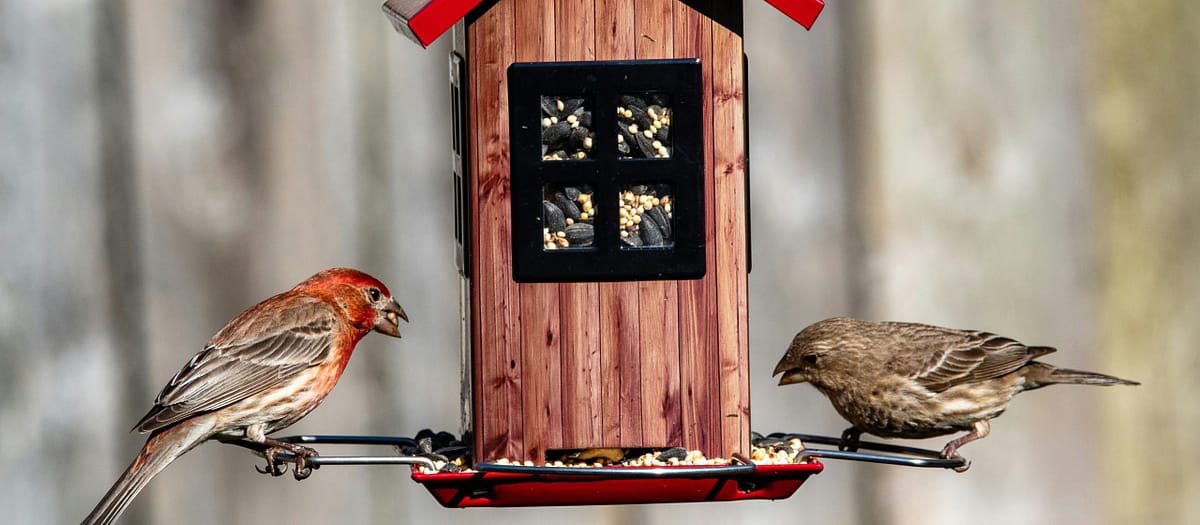
House Finches are social, streaky little birds with males showing rosy-red coloring on the head and breast. They travel in flocks and can empty a tube feeder quickly. They love sunflower seeds and nyjer seed. House Finches are present year-round in Illinois and are especially visible at feeders from fall through early spring.
9. Dark-eyed Junco
Often called “snowbirds,” Dark-eyed Juncos arrive in Illinois in October and stay through March or April. They’re small, slate-gray birds with white outer tail feathers that flash when they fly. Juncos are ground feeders, so scatter millet under your feeder or use a low platform tray. Their arrival is a reliable sign that fall is truly here.
10. American Robin
The American Robin is Illinois’s state bird and one of the most recognizable birds in North America — orange-red breast, dark back, cheerful song. While robins don’t typically visit seed feeders, they love fruit (plant berry-producing shrubs like winterberry or crabapple) and will forage for earthworms on your lawn. Robins are present year-round in the southern half of Illinois; in the north, most leave for the winter.
11. Mourning Dove
Plump, soft-voiced, and surprisingly fast in flight, Mourning Doves are among the most abundant birds in Illinois. They’re ground feeders that gather below feeders to clean up spilled seed. Millet and safflower are their favorites. If you want to bring doves in, a platform feeder placed low to the ground works best.
12. Song Sparrow
One of the most common sparrows in the Midwest, the Song Sparrow has a streaky brown pattern and a bold central breast spot. They sing persistently and melodically from shrubs and brushpiles. Song Sparrows prefer millet and cracked corn, and they breed in Illinois before many move south for winter — though some stay year-round in the southern counties.
Seasonal Illinois Bird Highlights
Fall Migration (September–November)
September is one of the best months for backyard birding in Illinois. Warblers, thrushes, and sparrows funnel through in huge numbers, and you might spot species you never expected in your yard. Keep water available — a bird bath draws migrating birds that don’t visit feeders. Check our guide on fall bird migration and which birds pass through your yard for tips on maximizing your September sightings.
Winter Feeding (December–February)
Illinois winters can be harsh, especially in the north, and birds that stay depend on reliable feeders to survive. Cardinals, chickadees, juncos, nuthatches, and woodpeckers all benefit from high-energy foods like sunflower seeds and suet. Keeping feeders stocked and water unfrozen makes a genuine difference for wintering birds.
Spring Migration (April–May)
Spring migration through Illinois can be spectacular. Orioles, warblers, hummingbirds, and tanagers all pass through. Put out an oriole feeder with grape jelly and orange halves in late April, and have your hummingbird feeder up by May 1st.
🔍 Find YOUR Illinois Backyard Birds — Free Tool
The birds you see depend on your exact location in Illinois. A birder in Chicago’s north suburbs sees different species than someone feeding birds in Shawnee National Forest downstate. Use our free Backyard Bird Zip Lookup Tool to get a personalized list of birds likely in your area:
🐦 What Birds Are in MY Backyard?
Enter your ZIP code to get a custom bird list for your exact Illinois location — including which feeders and seeds attract each species.
Recommended Feeders for Illinois Birds
Illinois birds are diverse, and different species prefer different feeder styles. Here’s a quick setup guide:
- Cardinals & Blue Jays: Hopper feeder with wide tray filled with black oil sunflower seed
- Goldfinches & House Finches: Nyjer/thistle tube feeder with metal mesh for multiple birds
- Woodpeckers & Nuthatches: Double suet feeder with weather guard, hung near a tree
- Blue Jays & Mourning Doves: Platform feeder with peanuts, corn, and sunflower seed
- All feeders: Mount on a 85-inch feeding station pole to keep feeders squirrel-free and at the right height
Not sure which feeder is right for you? Read our complete guide on how to set up a bird feeding station for beginners — it walks you through everything from pole placement to feeder height.
Frequently Asked Questions
What is the most common backyard bird in Illinois?
The Northern Cardinal is arguably the most recognized and beloved backyard bird in Illinois. It’s a year-round resident throughout the state and visits feeders in all seasons. Close runners-up include the Black-capped Chickadee, Downy Woodpecker, and American Goldfinch — all abundant and easy to attract with the right food.
What birds are in Illinois in the fall?
Fall is an exciting time for Illinois birders. In addition to year-round residents like cardinals and chickadees, September and October bring waves of migrating warblers, sparrows, thrushes, and raptors. Dark-eyed Juncos typically arrive in October and stay all winter. White-throated Sparrows and Fox Sparrows also appear during fall migration. It’s one of the most active birding seasons in the state.
How do I attract cardinals to my Illinois yard?
Northern Cardinals love black oil sunflower seeds and safflower seeds — both of which squirrels tend to avoid, making safflower a smart choice. Place a hopper feeder within 10–15 feet of trees or dense shrubs, as cardinals are cautious birds that like nearby cover. They’re also more active at dawn and dusk than midday, so don’t be surprised if your feeder is quiet in the afternoon but busy at first light.
Do hummingbirds come to Illinois?
Yes! The Ruby-throated Hummingbird is the only regularly occurring hummingbird in Illinois, arriving in late April or early May and departing by October. Put your hummingbird feeder out by May 1st filled with a simple 4:1 water-to-sugar solution (no dye needed). Plant native flowers like cardinal flower, trumpet vine, and bee balm to keep hummingbirds visiting throughout the summer.
What’s the best seed mix for Illinois backyard birds?
For the widest variety of Illinois backyard birds, black oil sunflower seed is the single best choice — it attracts cardinals, chickadees, finches, nuthatches, and more. Add nyjer (thistle) seed in a separate feeder for goldfinches and house finches. Suet attracts woodpeckers and nuthatches, especially in fall and winter. Avoid cheap seed mixes full of milo and wheat — most birds simply throw those aside and waste your money.
Are there eagles in Illinois?
Yes! Bald Eagles winter along the Illinois and Mississippi rivers in impressive numbers — the Illinois River valley around Starved Rock State Park is one of the best eagle-watching spots in the Midwest from December through February. You won’t attract them to a backyard feeder, but a trip to a river bluff on a cold winter morning can be spectacular.
Start Watching Illinois Backyard Birds Today
Illinois is a rewarding state for backyard birding at any time of year. With the right feeders, seeds, and a little patience, you can attract dozens of species without leaving your yard. The best first step? Use our free Zip Lookup Tool to find out exactly which birds are likely in your Illinois neighborhood — and what to feed them.
Once you know who’s visiting, check out our beginner’s guide to identifying backyard birds so you can start putting names to faces. Happy birding! 🐦
Leave a Reply